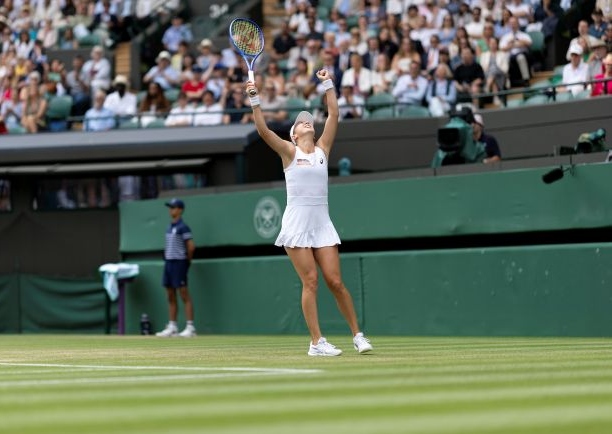
Photo credit: Jon Buckle/ROLEX
Grand Slam tennis requires tremendous timing.
Belinda Bencic knows all about proper pacing—and the value of pregnant pause.
World No. 35 Bencic beat talented teenager Mirra Andreeva 7-6(3), 7-6(2) to advance to her maiden Wimbledon semifinal today.
The 28-year-old Bencic made history as the second Swiss woman to reach the Wimbledon final four, following in the footsteps of her mentor, the legendary Hall of Famer Martina Hingis. Bencic continues her bid to become the third mom in Open Era history to win Wimbledon.
“It’s crazy, it’s unbelievable, it’s a dream come,” a beaming Bencic said afterward. “I tried not to think about it with the match points.
“I’m just speechless. It’s just my second Grand Slam final overall, and first at Wimbledon. I’m just speechless. I’m so happy.”
New mom Bencic did it all with baby on board. Bencic gave birth to daughter Bella on April 23rd, 2024.
Consider the 2021 Olympic gold-medal champion was ranked No. 1213 last November as she launched her comeback from maternity leave. Last February, the 28-year-old Swiss won her first title since becoming a mom in Abu Dhabi.
Today, 15 months after giving birth, Bencic scored one of her biggest wins that propels her to No. 20 in the live rankings.
A decade after winning her lone grass-court crown in Eastbourne, Bencic will face former world No. 1 Iga Swiatek tomorrow for a spot in Saturday’s final.
Earlier, former Wimbledon girls’ champion Swiatek stopped Liudmila Samsonova 6-2, 7-5, saving eight of 10 break points along the way. Swiatek surged into her first Wimbledon semifinal and has now reached semifinals or better at all four Grand Slam tournaments.
Bencic, who could be notoriously tough on herself earlier in her career, said she’s grateful for this inspired Wimbledon run.
“I’m very proud,” Bencid said. “All my career I didn’t say a lot to myself, but after having Bella I say it every day.
“We worked so hard on the comeback. We are just enjoying life on tour. Traveling with Bella, we’ve been able to create amazing memories. I’m just happy to be able to play again.”
This first meeting between the pair featured quality rallies with each woman trying to take offensive initiative.
Ultimately, Bencic overcame Andreeva’s superior speed and versatility by landing a higher first-serve percentage (74 percent), cracking deep drives down the line off both wings and persistently pounding the Russian’s weaker forehand wing until it bled errors.
“Obviously I’m a bit sad. Not a bit,” Andreeva said. “I am sad that I lost, but I just felt like she was playing good today.
“At some point I also felt like I could have played better, maybe a little bit more focused, maybe a little bit less mistakes, more aggressive. Yeah, today is the hard day, but I can take a lot of positives from these two weeks, for sure. We’re going to move on and improve.”
Forehand frailty was evident as the 18-year-old Andreeva, at times, went exclusively to the slice forehand because she wasn’t confident in landing her traditional topspsin forehand. Stats show 17 of Andreeva’s 35 unforced errors came from her unruly forehand wing, but truth be told it seemed like even more.
Still, despite the forehand failings, Andreeva put herself in position to win both sets only to see Bencic outplay her in both breakers. Andreeva betrayed her own cause with a brutal backhand miss in the first tiebreaker.
“Sometimes I feel like maybe it’s good to change the rhythm a little bit on the court,” Andreeva said of chipping her forehand. “Sometimes I use it as a defense. Sometimes I just feel like on grass the ball stays low. With the slice, it’s hard to kind of give good shape and put it uncomfortable for the opponent.”
A disconsolate Andreeva, who had not dropped a set before today’s quarterfinals, wiped away tears as she walked off court.
The first teenager to reach the Wimbledon quarterfinals since Victoria Azarenka and Sabine Lisicki in 2009, Andreeva stung 35 winners—15 more than her opponent—but grew a bit more defensive at crunch time of both sets.