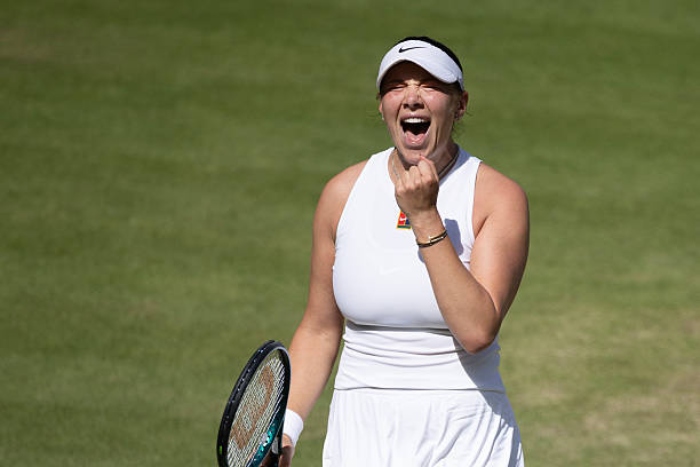
Sequels seldom match enthralling originals.
Unless Amanda Anisimova is directing the powerfully inspirational plot line.
Disarming the world No. 1 with sizzling drives, Anisimova toppled Aryna Sabalenka 6-4, 4-6, 6-4 to hit her way into the Wimbledon final.
“This doesn’t feel real right now,” a smiling Anisimova said in her on-court interview. “Honestly, Aryna is such a tough competitor. I was dying out there.
“I don’t know how I pulled it out. She’s such a tough competitor. She’s an inspiration to me and so many others. We’ve had so many tough battles to come out on top today and to be in the finals of Wimbledon is so incredibly special.
“I know she’s No. 1 but a lot of people were cheering for me so I just want to say a huge thank you to everyone.”
Six years after a 17-year-old Anisimova reached the Roland Garros semifinal and pushed Ash Barty to three sets, she made history at SW19.
The 23-year-old Anisimova is the youngest American woman since legendary Serena Williams in 2004 to reach the Wimbledon final. Anisimova extended an American major streak following Jessica Pegula (US Open), Madison Keys (Australian Open) and Coco Gauff (Roland Garros) as the fourth U.S. finalist in the last four majors.
On Saturday, Anisimova aims to join Keys and Gauff as the third American Grand Slam champion this season against either former No. 1 Iga Swiatek.
Former Wimbledon girls’ champion Swiatek crushed 2021 Olympic gold-medal champion Belinda Bencic 6-2, 6-0 in today’s second semifinal.
Playing for her first title since she swept Jasmine Paolini in the 2024 Roland Garros final, Swiatek said she expects fast, flat drives from Anisimova.
“I don’t think I we played on the WTA Tour, but we played in juniors,” Swiatek said of Anisimova. “She can play amazing tennis. She likes flat surfaces she has a flat game and plays fast so I’ll have to be ready for fast shots.
“I’m just going to try to focus on myself.”
Today’s first semifinal is branded an upset, but the truth is Anisimova has had Sabalenka’s number scoring her sixth win in nine meetings. Anisimova fought off 11 of 14 break points and belted her bold backhand crosscourt and down the line to mute the screaming Sabalenka’s charge.
Down a break in the deciding set today, Anisimova commanded the center of the court and blasted through four games in a row. Anisimova did not press the panic button when the US Open champion saved three match points.
Undaunted, Anisimova ripped a crosscourt forehand winner to close a rollercoaster ride of a match in two hours, 37 minutes.
It is Sabalenka’s third straight Wimbledon semifinal loss.
Cearly, this one will sting, but make no mistake: Anisimova won this match more than Sabalenka lost it.
“I mean, losing sucks, you know? You always feel like you want to die, you don’t want to exist anymore, and this is the end of your life,” Sabalenka said afterward. “But then you sit there a little bit, and you think about what you could have done differently on the match. I mean, you see stuff where you wasn’t at your best in the match. You see that the other player perform much better. You kind of, like, can see things better.”
This triumph continues a captivating comeback for the woman who was born in Bruce Springsteen’s hometown, Freehold, New Jersey.
It’s a major leap forward in her journey back after taking a six-month break from tennis to focus on mental health. Anisimova, who began playing at the age of 3, said tennis had become “unbearable” for her after experiencing burn-out since the summer of 2022.
hree-time major champion Sabalenka saved a match point and broke back for 4-5.
It looked like the Belarusian, who battled back from a break down in the decider to beat Laura Siegemund in the quarterfinals, was poised for a comeback.
Anisimova pressed mute racing to a love-40 triple match point lead. Though Sabalenka saved two more match points, Anisimova calmly ripped that final forehand winner to close the biggest win of her career with a wide smile.
Ultimately, Anisimova played the pivotal points with bold aggression. Anisimova saved 11 of 14 break points and won 24 of 40 points played on her second serve (60 percent).
Pointing to her inability to convert more of those break points, Sabalenka said her return game cost her the match, while crediting Anisimova for being “more brave” when it mattered most.
“I have to say that I did my best. I gave everything I had at the moment,” Sabalenka said. “Okay, return game didn’t work well. I still came back. I still had chances. Then the last game I didn’t serve. I mean, I did serve, but she just smashed my serves.
“I have to say that she was more brave today. Maybe when I was just, like, trying to stay in the point, she was, like, going for all — she was playing more aggressive. Sometimes I was just stopping my arms, making like mistakes which I shouldn’t be making.
“I think I should have been a little bit more brave today.”