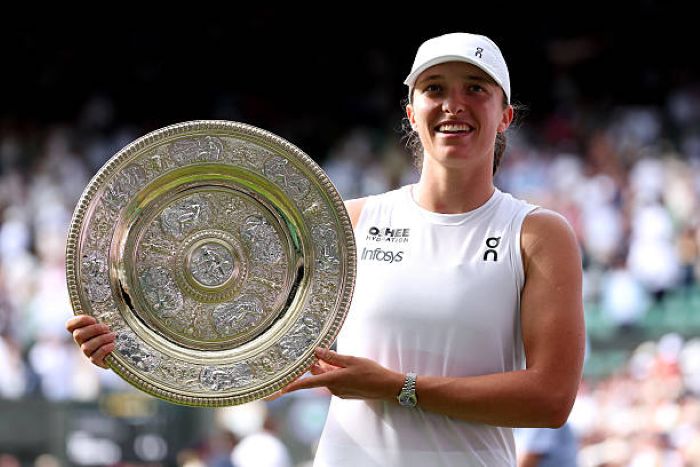
Iga Swiatek dished the first double bagel in a Wimbledon ladies’ final in 117 years to make
history as the first Polish singles player to win Wimbledon. Photo credit: Julian Finney/Getty
By Alix Ramsay
You had to feel for Amanda Anisimova. A year ago, she was ranked No.189 in the world and lost in Wimbledon’s qualifying tournament.
Now, here she was in the Wimbledon final. She was ranked No.12 with a place in the top 10 assured for next week. She had a huge game, an inner belief… and she was taking an absolute hiding from Iga Swiatek 6-0, 6-0.
The only upside was that it was quick. At least Swiatek did not drag out the torture for Anisimova. She put her to the sword swiftly and clinically.
The punters must have been a bit miffed, though. The most expensive Centre Court tickets were £315 each. The match took 57 minutes. That works out at £5.53 a minute. And the only vaguely competitive rally they saw all afternoon was the last one. And Anisimova lost that one, too – obviously.
It was all too much to bear for the American. She spoke well on court, or she did when she could stop the sobbing, but it was painful to watch her go through it.
“Iga, you’re such an incredible player,” she said through the tears. “It’s obviously showed today, so you’ve been such an inspiration to me. An unbelievable athlete and you’ve had such an incredible two weeks here: getting to the final first of your first Wimbledon, and winning the championship, it’s so special, so congratulations.”
She got through that bit reasonably well but then she came to thanking her team and her family, the people who had helped back from an eight month break to recover from burnout and mental health issues. The people who believed that she could finally fulfil the promise of her teenage years as a wunderkind. The people she had needed and leant on. She was in floods as she tried to do that.
“You guys have been there for me,” she said. “Some of my family flew in. I mean, it was so unbelievable to experience this with you all. And I wouldn’t be standing here if you guys didn’t fly in and support me throughout the rest of the tournament.
“You guys were that extra motivation and inspiration that I needed. And you kept pushing me forward and you guys have always believed in me. And My mom who has done more work than I have….”
And then she lost it completely. She recovered. This was difficult but it was her Wimbledon final experience and she still treasured it.
“A few more words,” she went on, “my mom worked so hard to get me to this point in my life, so. So thank you for being here and breaking the superstition of flying in. I mean, it’s definitely not why I lost today. I’m so happy that I get to share this moment and for you to be here and witness this in person.”
Much had been made of Anisimova’s run of 28 straight wins after winning the first set. Much as that is an admirable achievement, the first set is not the important one; it the woman who wins the last set who wins the match. And anyway, after the first 14 minutes, the idea of winning the opening set seemed remote – she was a double break down and looked as tight as a drum.
We shall draw a veil over her first service game – the jangling of her first final nerves was deafening her – and her second was only marginally more noteworthy. But two double faults and variety of other fluffs cost her dear.
Seven minutes later, she dropped her serve again and Swiatek was skipping to a bagel set. Had Anisimova tied the Pole’s shoelaces together, Swiatek would still taken mopped up every game.
The first set stats made cruel reading. The American won a measly nine points; her first serve was only finding its mark 33 per cent of the time and she was winning the point behind it only 28 per cent of the time. And then there were the 14 unforced errors. We ignored Swiatek’s stats as it was a bit like reading the class swot’s report card.
Could this be the same Anisimova who had outhit and outlasted Aryna Sabalenka in the last round? Ah, but that was a grand slam semi-final and she had been in one of those before (Roland-Garros 2019). The was a final; this was a different ball game entirely.
Swiatek, though, was not worried about any of that. She was her ruthlessly solid self from the moment she walked out on to the court. For the first time in her life, she feels comfortable on the grass. Happy, even.
Year after year she has rolled into Wimbledon as the champion of Roland-Garros and having won almost all of her clay court matches in the previous months. She has been mentally and physically fried and she has been harried by the constant questioning: do you think you can win Wimbledon this year? How come you can win everywhere else but not Wimbledon?
This year has been different. With not a title to her name since Roland-Garros last summer and with a string of duff results and a doping ban behind her, she has not been the focus of attention. With less matches in her legs, she is fresher. And with nothing to do on the final weekend of the French Open, she was able to start her grass court preparations earlier than usual.
The result has been a more confident grass court Iga which, in turn, has led to a cheerier Iga. She thinks the ball is speaking to her this year (she is obviously not a less ethereal Iga) and she has been enjoying every day in south west London. Then again, if you are splattering everyone who stands in front of you and collecting three million quid for doing it, you’d enjoy it, too.
When it was all over, Swiatek made the now customary sprint up to her team in the players’ box. Anisimova quietly headed off court for a cry and an attempt to compose herself before the trophy ceremony.
Swiatek had been blisteringly good throughout the fortnight and she did not let up for a second in the final. She deserved her victory; she deserved the plaudits and the respect.
But you had to feel for Amanda Anisimova.