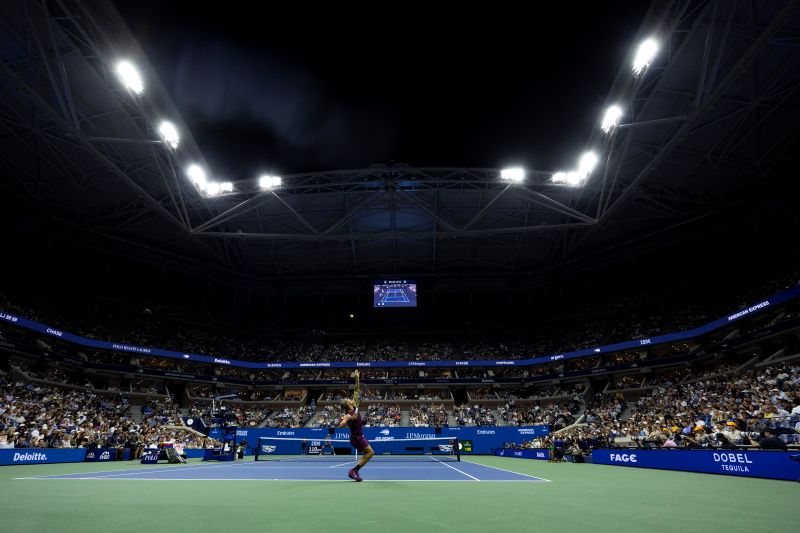
Photo credit: Jed Jacobson/ROLEX
By Alix Ramsay
The phrase “less is more” is often attributed to Mies Van der Rohe, the pioneering architect of the minimalist movement but, in truth, he was not the first to follow the philosophy.
When it comes to philosophy, the ancient Greeks had a similar saying: “philosophers: keep it brief”. These philosophers were clearly freelancers and were paid by the word and, as a result, their mouths had a tendency to runneth over. For the listeners, though, enough was enough.
But whoever said it first, for Van der Rohe, it was the very essence of purity in design. To strip away the ornamentation, the fluff and the frippery; to focus entirely on the simplicity of the structure itself – that was the path to perfection. Yes, it was functional; yes, some baulked at its stark and almost industrial appearance but this was, to the architect, design at its purest and most powerful. Less was indeed more.
And then there is the US Open. Here in Flushing Meadows, more is most definitely less. Sadly.
By extending the tournament to 15 days, the Open managed to begin not with a bang but a whimper. At the same time, the poor punters – who flock through the turnstiles every day like a tide of humanity – are paying through the nose for less than they got this time last year: less matches on days one to three.
The US Open is not the only slam to add an extra day to their schedule in search of more ticket sales, more merch flogged to the cash-rich and taste-free and more sponsors’ beverages ladled out at eye-watering prices. It started with Roland-Garros almost 20 years ago; the Australian Open followed last year and now New York has joined in the fun and games.
Only Wimbledon remains, staunchly and resolutely, a 14-day event. When asked before The Championships this summer whether there was any thought to add another day, the response was clear: “No.” Had the idea been penciled in for discussion in the near to medium future? “No”. Was there any chance that…“No.” That would be a no, then.

Photo credit: Jed Jacobsohn/ROLEX
To be fair, my people are still recovering from the shock of having to play on the middle Sunday in SW19 (we have done this for the last four years and still it comes as a jolt to the system). Wimbledon, then, has done as much tinkering with tradition as it wants to for now.
Back at Roland-Garros, it took years before they managed to make those first three days of the tournament feel like the proper start of the greatest clay court championship in the world. Now, after the 20th edition of the 15-day event, it does feel normal and each day does feel important. But at first, the casual observer (and, let’s face it, a lot of the people who come to the slams are very casual observers of tennis) just saw random matches spread out thinly over too many courts and too many days.
In New York, that is the feeling this summer. It is not the USTA’s fault that the draw fell the way that it did. The men’s draw offered up no mouth-watering first round ties and while the women’s draw gave us Venus Williams against Karolina Muchova (and a decent match, too, as Venus warmed to her task before losing). But Venus, at 45, playing anyone was a story. And then she lost.
On Day Three of the Open, the punters were in jolly mood on the 7 train in the morning. They were going to the tennis. Some lucky souls had day session tickets for the Arthur Ashe Stadium: they were going to see the resurgent Iga Swiatek, former world No.1, current world No.2 and the champion of Wimbledon and Cincinnati. After that they would see Jannik Sinner, the world No.1, the champion of Australia and Wimbledon and the runner up at Roland-Garros. This was going to be a cracking day.
And then Swiatek marmalised Emiliana Arango of Columbia in one hour exactly. She lost just three games and looked frighteningly aggressive. Taking one look at that, Sinner marched on to court against to take on Vit Kopriva of the Czech Republic and marched off again 99 minutes later having flattened his foe 6-1, 6-1, 6-2.
As the crowd piled out of the Ashe Stadium, Linda Noskova and Dalma Galfi were sent out (Noskova won and good on her) but this is not the centre court schedule we were expecting.
Those cheery souls on the train had paid between $200 and $300 for their tickets (let us not worry about those who can afford hospitality boxes and the like) and they had seen 159 whole minutes of deeply average tennis from the big stars. Swiatek and Sinner are serial champions; they do what they need to do to win and their opponents on Tuesday made that very easy for them.
Neither Swiatek or Sinner can be blamed for any of this – they did their jobs and did them well. But when both of them came to talk to the media, Swiatek talked almost exclusively about Taylor Swift (she has always been a fan; a nation gasped) and Sinner gave his thoughts on Carlos Alcaraz’s new haircut (Jannik was his usual diplomatic self – “everything suits him,” he said) and waffled on a bit about not practising as much in his rest days as he used to.
It was not gripping stuff: no value for money for the fans, no matches worth remembering and no story to tell at the end of it all.
It is true that professional sport is part of the entertainment industry but the clue is in the name: “sport”. If it is reduced to short-format, hit-and-giggle mixed doubles, first round “action” that takes days to complete with little thought for the ticket holders’ outlay and is entirely dependent on how many glasses of $23 Honey Deuce or $16 Heineken that can be sold to wash down the $39.50 lobster roll (which comes with a bag of chips – you lucky, lucky people), then the “sport” element is lost.
Historically, the US Open was always the most brutal of the slams. To win here was worthy of a medal, no matter the huge pay cheque and the trophy. The journos thought much the same just for covering it. The US Open was always special.
Which brings us back to Mies Van der Rohe. The US Open does not need every whistle and bell to make it stand out from the rest; it just needs the players to be given the chance to play their best in front of crowds who are being shown the best in a format and schedule that showcases that talent. Dammit: less is more. Leave it at that.