By Alix Ramsay
That’ll teach Jannik Sinner to win a grand slam title on one of Carlos Alcaraz’s preferred surfaces.
When the tall, red-headed Italian brushed his only true rival aside in the Wimbledon final, he stuck a large, pointy stick into a hornets’ nest. He did not realise it at the time, but this would not end well.
Until then, the two new bosses of the men’s tour had carved things up nicely between them: Sinner won the hard court slams and Alcaraz won on the natural surfaces.
It suited them to a tee. Sinner is pinpoint accurate and relentlessly efficient; the hard courts are made for him. Alcaraz, the more creative of the two, can adapt to the changing nature of the surface beneath his feet and still conjure up the impossible.
And then Sinner won Wimbledon.
After that, Alcaraz said, cheerfully, that losing to Jannik like that simply made him better. And he was grateful for that. Jannik had got stronger physically in the last couple of years – that made their battles all the closer. In reply, Sinner said that Carlos’s serve had improved immeasurably and that, too, made their battles tighter.
But what both of the knew was that Sinner was the precise and ruthless ball striker. He never lets up. When he is in top gear, he is hellishly difficult to deal with and his concentration never wavers.
Alcaraz, on the other hand, can be fabulous for a set and then careless for a set. It had won him five grand slam titles – the sheer chutzpah to believe that he could come back from three championship points down at Roland-Garros being proof positive – but it was still a flaw.
And then Sinner won Wimbledon.
When, at last, the final began in New York (more of which more below), it was a different Alcaraz who walked on to the Arthur Ashe stadium. There were no smiles, no cheery waves; he had a face like thunder – totally locked in to the task ahead and with no time for fripperies. This was new. This was dangerous for Sinner.
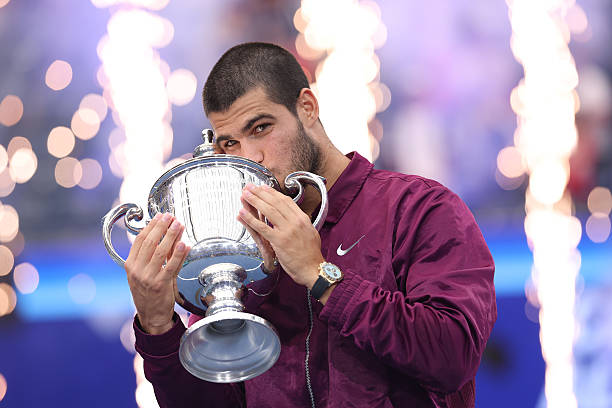
And so it proved. Alcaraz won 6-2, 3-6, 6-1, 6-4 and in so doing barged Sinner off the top rung in the rankings ladder and is now the new world No.1. Sinner’s 65 weeks as king of the world are over.
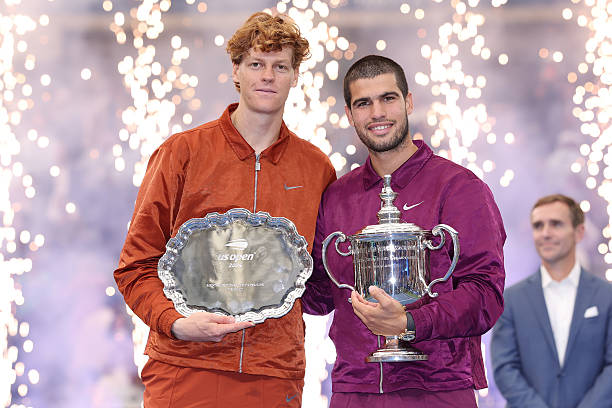
Alcaraz dominated the first set; his forehand was ferocious and his serve was untouchable (he dropped three points on his first serve). Sinner came back in the second set, trying to give Alcaraz a taste of his own medicine and, for a while, it worked.
The top seed broke for 3-1. Carlos kept his focus. Sinner moved on to a 5-2 lead and suddenly Alcaraz was remonstrating with himself – he was not happy and it showed. But then, just a couple of minutes later, he was back on track. The set was gone but he made sure that his tormentor would have to serve it out. The match face was back in place. That was also something new.
Thereafter, Sinner was always chasing after Alcaraz’s vapour trails.
But maybe now the two-time US Open champion and six-time grand slam winner has poked his own pointy stick into the hornets’ nest. Sinner was completely honest in assessment of his loss: he has to change to challenge the new Carlos.
“He has improved,” the new world No.2 said simply. “I felt like he was a bit cleaner today. The things what I did well in London, he did better today.
“I was very predictable today. The way of he did many things, he changed up the game. That’s also his style of how he plays. Now it’s going to be on me if I want to make changes or not.
“I feel like it depends how you arrive to play against Carlos. You know, matches before are comfortable but you always do the same things, like I did, for example, during this tournament. I didn’t make one serve-volley, didn’t use a lot of drop shots, and then you arrive to a point where you play against Carlos where you have to go out of the comfort zone.
“So I’m going to aim to, you know, maybe even losing some matches from now on, but trying to do some changes; trying to be a bit more unpredictable as a player, because I think that’s what I have to do, trying to become a better tennis player.”
Yet Alcaraz, who studied and analysed every moment of that Wimbledon final, has learned his lesson already.
“Since the first rounds to the end of the tournament, the best tournament so far that I have ever played,” he said. “ The consistency of my level during the whole tournament has been really, really high, which I’m really proud of, because it’s something that I’ve been working on, to be really consistent. I think this tournament I saw that I can play really consistent.”
The coming year is appetising for both Alcaraz and Sinner. For the other boys in the locker room, those who play in a different zip code to the world’s top two, 2026 looks grim.
And finally…
This was the day that President Trump came to the US Open. Love him or loathe him (I am a Brit; he is not my president so I have no place offering an opinion), he is still the president of one of the world’s superpowers. So he gets the full security treatment. As he should.
But whoever thought it would be a good idea to invite him to the US Open men’s final (he was a guest in the Rolex suite) had clearly not thought this through.
The match start time was 2pm. Satellite links were booked for broadcasters the world over. Fans were streaming towards Flushing Meadows in their thousands. And then we got to 2pm and nothing happened.
The grounds were packed tight with punters trying to get to their seats. From the South Plaza Gate and into the South Plaza – that vast area outside Ashe Stadium – people were stacked shoulder to shoulder; the queue snaked out and around Grandstand. And very few knew why.
The camera crews were out and about with reporters asking the paying – hugely paying – public what they thought of it all. Surprisingly, very few of them knew what the fuss was all about. And most of them missed the whole of the first set of the final. And had stuff from their bags – from water bottles to cigarette lighters through to things they had bought in the gift shops – taken away from them.

Photo credit: US Open Facebook
Given the USTA had the wherewithal to send out a missive to all broadcasters asking them not to focus on any booing when President Trump appeared, you might have thought they could send out another directive to all ticket holders to get there early and not bring too much stuff with them. After all, the tickets are all digital so there must have been a way to communicate with those who had tickets. But no. (Oh, and the European media ignored the booing directive. We are like that across the pond.)
The poor people who were shut outside while Alcaraz won the first set got nothing other than yet another security check and the chance to watch only half a final. As we would say in Britain: it was a poor show. A very poor show.